Home · Insights · Horn of Africa
Sudan's Army Says It Broke a Two-Year Siege of a Regional Capital. It Made the Same Claim in February 2025, and the Offensive That Did It This Time Has Already Killed at Least 13 Civilians.
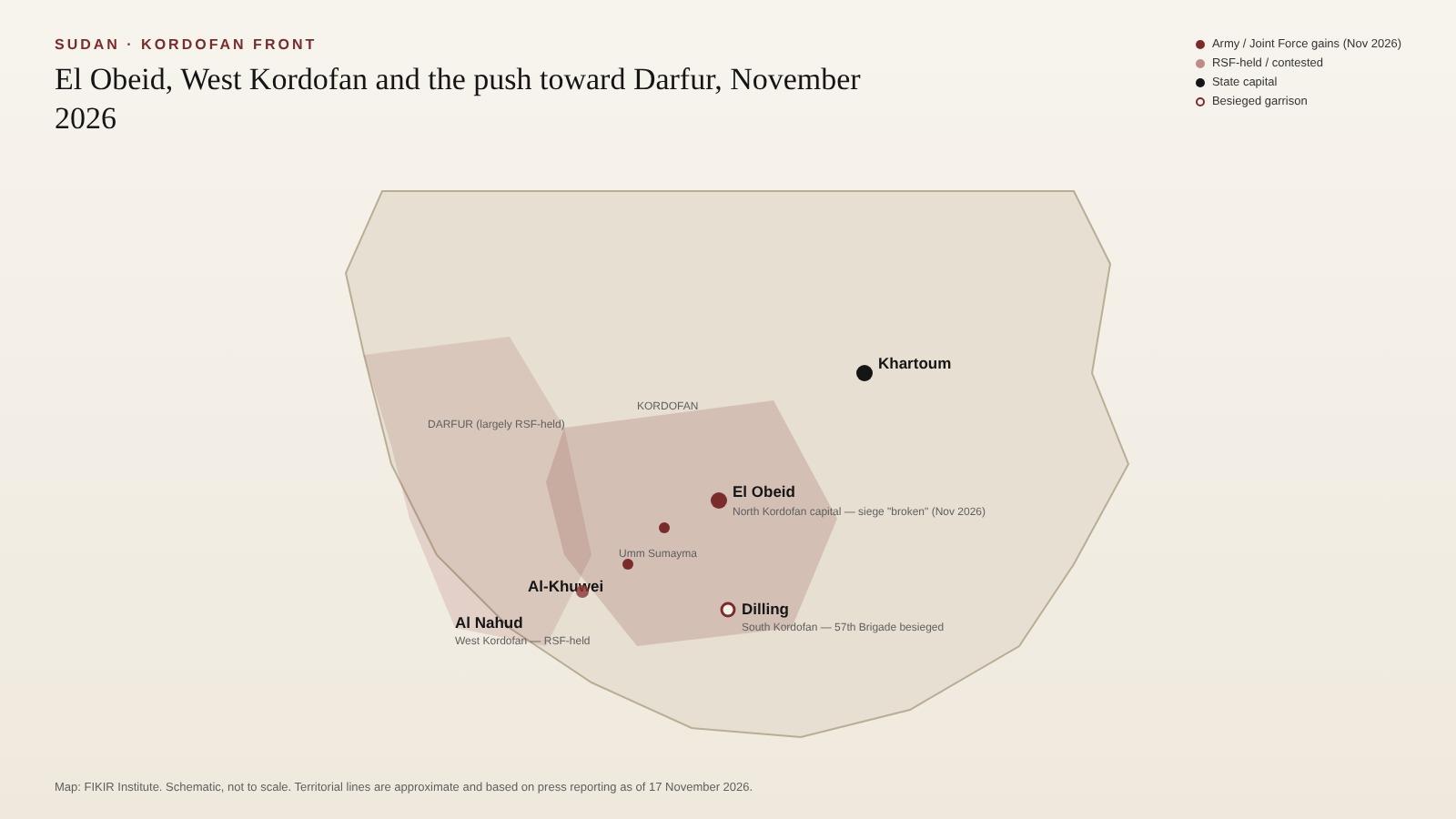
Sudan's army and an allied force of former Darfur rebel movements say they have broken the Rapid Support Forces' roughly two-year siege of El Obeid, the capital of North Kordofan state, capturing Umm Sumayma and a string of surrounding settlements in the week to 17 November, according to Al Jazeera and the territorial-control tracker Sudans Post. The army made an almost identical claim in February 2025, after which conditions in the city worsened again; Al Jazeera reported in July that ten consecutive days of drone strikes had killed at least 50 civilians there. The same westward push that produced this week's gains has its own civilian toll: a Sudanese army airstrike on the village of Abu Qalb in West Kordofan on 16 November killed at least 13 people, including women and children, according to the rights-monitoring group Emergency Lawyers, cited by the Associated Press, while an army Special Operations Forces spokesperson said only that his troops had "eliminated" Rapid Support Forces positions in the area. Roughly 200 kilometres south, in Dilling, a separate army brigade has been under RSF and SPLM-N siege for two years with no claim of relief.
FIKIR Institute · 18 November 2026 · 9 min read
Audio reading is ready.
Abstract: Sudan's army and the Joint Force of armed Darfur movements allied with it, principally Minni Minnawi's Sudan Liberation Movement and Jibril Ibrahim's Justice and Equality Movement, say their offensive across North and West Kordofan has broken the Rapid Support Forces' (RSF) long siege of El Obeid, capital of North Kordofan state, after capturing Al-Khuwei on 13 November and Umm Sumayma and surrounding settlements by 17 November, according to Al Jazeera's 14 November analysis and the territorial-control tracker Sudans Post. The stated next objective is Al Nahud, West Kordofan's largest city and still RSF-held, as part of a campaign aimed at eventually reopening the highway linking central Sudan to Darfur, which remains largely under RSF control. The claim is not Sudan's first: the army announced it had broken the same siege in February 2025, nearly two years after the RSF first encircled the city in mid-2023, and the respite did not hold, with Al Jazeera reporting in July 2026 that ten consecutive days of drone strikes had killed at least 50 civilians across El Obeid and North Kordofan. The current offensive carries its own documented civilian cost: a Sudanese army airstrike on the village of Abu Qalb, in West Kordofan's Abu Zabad locality, killed at least 13 civilians, including women and children, on 16 November, according to the rights-monitoring group Emergency Lawyers as reported by the Associated Press, part of what Sudan Tribune described as roughly a week of intensive airstrikes on villages around El Khuwei and En Nahud. Neither the army nor independent monitors have resolved a separate, longer-running siege roughly 200 kilometres south in Dilling, South Kordofan, where the army's 57th Infantry Brigade has reportedly been encircled by RSF and SPLM-N forces for two years. The United Nations' Independent International Fact-Finding Mission for the Sudan reported in September that a network running through the United Arab Emirates, Chad, southeastern Libya and Somalia's Puntland state continues to supply the RSF side of the broader war, a finding FIKIR Institute examined on its own terms in September, underscoring that the Kordofan front, however it resolves, sits inside a conflict shaped as much by outside patrons as by the two Sudanese forces fighting it.
A siege Khartoum already claimed to have broken once
El Obeid's ordeal did not begin this year. The RSF seized the city's airport in the opening weeks of Sudan's civil war in 2023 and tightened a full encirclement soon after, turning the North Kordofan capital, a city of roughly half a million people and a strategic junction between Khartoum and Darfur, into one of the war's longest-running sieges. The army first announced it had broken that siege in February 2025, in an operation Sudan War Monitor and wire reporting at the time described as reopening the roads into the city after RSF morale and logistics collapsed across large parts of Kordofan. That relief proved temporary. By July 2026, Al Jazeera was asking directly whether El Obeid risked becoming "Sudan's next el-Fasher," reporting that ten consecutive days of RSF drone strikes had killed at least 50 civilians across the city and the wider province, and other outlets, including Middle East Eye and Dabanga Sudan, documented repeated strikes on shelters, a university dormitory and displaced-persons sites in the intervening months. The November 2026 declaration that the siege has been broken a second time is, on its own terms, an acknowledgment that the February 2025 claim did not describe a durable outcome, a pattern Sudan War Monitor has separately noted recurring elsewhere in Kordofan, where RSF counterattacks have reversed several of the army's prior territorial claims.
This week's gains: Al-Khuwei, Umm Sumayma and a road toward Darfur
The immediate military sequence is reasonably well documented across multiple outlets, even if none of it has been independently verified by a neutral monitor. Sudan Tribune reported that the army and the Joint Force of armed movements took the West Kordofan town of Al-Khuwei on 13 November, after first capturing Serif Ankoush roughly 20 kilometres to its west, in a multi-axis operation. The following day, Al Jazeera's analysis credited the same combined force with having "so far" broken the RSF's siege of El Obeid and its surrounding areas, citing the Al-Khuwei capture and further gains west and south of the North Kordofan capital. By 17 November, Sudans Post's territorial-control tracker and a separate Sudan War Monitor dispatch both reported that army units and the Joint Force had pushed through to Umm Sumayma and a string of nearby settlements, consistent with the stated aim of eventually reopening the highway that links central Sudan to Darfur, where the RSF still controls most territory. Minnawi's forces have made similar declarations after earlier Kordofan gains; TRT World quoted him describing an earlier capture in the same province as "not the end of the battle, but the beginning of a new phase of decisive action," a framing that, as with the army's own February 2025 announcement, is a combatant's characterization of an unresolved war rather than an independently confirmed turning point.
The cost of the advance: Abu Qalb and a week of airstrikes
The same offensive that produced this week's territorial claims has also killed civilians by the army's own side's hand. The Associated Press reported, citing the Sudanese rights-monitoring group Emergency Lawyers, that an army airstrike on Abu Qalb, a village in West Kordofan's Abu Zabad locality, killed at least 13 people on 16 November, including women and children; the AP said it could not independently verify the toll. Emergency Lawyers called the strike a violation of international humanitarian law. An army Special Operations Forces spokesperson did not dispute that a strike had occurred, telling reporters only that his forces had "eliminated" RSF positions in the area. Sudan Tribune's separate reporting placed that strike inside a roughly week-long campaign of intensive airstrikes on villages around El Khuwei and En Nahud, with further strikes reaching Um Bader in North Kordofan, and described a mass exodus of residents southward out of Abu Zabad locality and the closure of local markets as the bombardment continued. No outlet reviewed for this analysis reports an independent casualty count for the broader air campaign beyond the Abu Qalb toll, leaving the full civilian cost of the offensive that "broke" El Obeid's siege undocumented even as the territorial narrative is treated as a battlefield turning point.
A second siege, in a different Kordofan town, that nobody claims to have broken
The offensive's stated next steps describe a war still only partially resolved on the army's own terms. Reporting on the broader Kordofan campaign places the army's 57th Infantry Brigade, part of its 14th Infantry Division, under a separate RSF and SPLM-N siege in Dilling, roughly 200 kilometres south of El Obeid in South Kordofan, a siege that by multiple accounts has lasted about two years with no comparable claim of relief. Sudan Tribune's coverage of the westward push toward Al Nahud frames that advance explicitly as a prelude to eventually reaching Dilling, not as a resolution of it. That a second, longer-unresolved siege sits inside the same province the army is describing as a site of momentum is a detail absent from the headline claims that El Obeid has been freed, and it suggests the Kordofan front remains a patchwork of claimed victories and unresolved encirclements rather than the kind of decisive shift the November reporting's framing implies.
The outside hands: Gulf patrons and the Horn's own transit routes
Sudan's war has never been purely Sudanese, and the Kordofan front sits inside that wider pattern. The UN Human Rights Council's Independent International Fact-Finding Mission for the Sudan reported on 3 September that it had "reasonable grounds to believe" a transnational network linking the United Arab Emirates, Chad, southeastern Libya and Puntland, in Somalia, continued to move weapons, foreign personnel and logistics to the RSF, a finding FIKIR Institute examined in detail at the time for its implications for Somali territory. The UAE has repeatedly denied arming the RSF. Egypt, by contrast, has backed the Sudanese army diplomatically and, according to multiple reports reviewed in FIKIR Institute's prior coverage of Sudan-Ethiopia tensions, is widely understood in the region to favour Khartoum's side of the war. Neither government's role changes the facts on the ground in Kordofan, but it means that a Sudanese army statement about an offensive's progress, and an RSF-aligned network statement to the contrary, are each also, in part, claims made on behalf of external patrons whose interest in the war's outcome is not confined to Sudan's own borders, a dynamic that extends the Kordofan front's relevance beyond Sudan into the Horn of Africa and Red Sea states that already host its supply lines.
What to watch
First, whether the RSF mounts a counterattack in North or West Kordofan comparable to the reversals Sudan War Monitor has documented elsewhere in the province, which would test whether November's "broken siege" claim fares better than February 2025's. Second, whether any independent monitor, the UN, ACLED or a humanitarian agency, publishes a casualty count for the week-long airstrike campaign around El Khuwei and En Nahud beyond the Abu Qalb toll, given that no outlet reviewed for this analysis offers one. Third, whether the army's push toward Al Nahud produces any movement on the separate, two-year siege of its own 57th Infantry Brigade in Dilling, the one encirclement in the same province that no side has yet claimed to have resolved. Fourth, whether the army's advance continues toward Darfur as stated, which would test whether the Kordofan campaign is a genuine prelude to contesting RSF-held Darfur or a more contained set of provincial gains whose strategic significance is, as with prior Kordofan claims, overstated in the moment it is announced.
Policy implications
For Sudan's army and the Joint Force, repeating a claim that already failed to hold once, without producing independent verification or addressing the civilian toll of the campaign that produced it, risks the same credibility problem FIKIR Institute has observed in other combatants' unverified battlefield claims this month: a declared victory that outside observers cannot test is weak currency with the international audiences, the UN Security Council, humanitarian donors, whose attention and funding Khartoum needs. For civilians in Abu Zabad locality and the villages around El Khuwei and En Nahud, the practical consequence of the offensive so far is displacement and at least 13 confirmed deaths from the liberating force's own airstrikes, a cost that the territorial narrative of a besieged capital's relief does not capture. For the RSF and its external backers, a confirmed loss of Al-Khuwei and the approaches to El Obeid, if it holds, narrows the paramilitary's position in Kordofan without yet touching its core strength in Darfur, where the war's most documented atrocities, including the UN-identified "hallmarks of genocide" in El Fasher, have occurred. For the Horn of Africa and Red Sea states already implicated in Sudan's supply lines, Somalia's Puntland among them, the war's continuation on a new front changes little about the external logistics the UN's fact-finding mission has already documented, and a Kordofan front that proves as reversible as El Obeid's first "liberation" in 2025 would extend, rather than resolve, the period in which those external networks remain active.
Related Analysis
- A House Republican Wants to Pay Ethiopia and Eritrea Not to Go to War, With Soybeans and Mining Rights. He's Open About the Other Reason: Keeping China Out of Their Minerals.
- Somalia Gave the UAE's Ambassador 72 Hours to Leave, Accusing Abu Dhabi of an 'Open Invasion' of Its Sovereignty. Puntland, Jubaland and Somaliland Have Already Said the UAE Isn't Going Anywhere.
- Yemen's Government Said in October It Had Cut the Houthis Off From the World's Most Fought-Over Strait. Five Weeks Later It Walked Away, and the Houthis Took Perim Island Back.
- The US Just Walked Away From Its Main Somalia Airfield, Blaming a Broken Runway. It Is Leaving Six Weeks Before the Entire Coalition Fighting Al-Shabaab Loses Its Funding and Its Two Biggest Armies.